
3V NPS: Baseline performance in 90 seconds
Most senior leaders can identify their busiest teams. Very few can tell you which ones are high performing.
As digital performance coaches, we’re regularly asked by leaders “What does a high performing team look like and feel like?”.
3V Net Performance Score (NPS) helps you answer that question. It’s a consistent way to baseline team performance that you can complete in 90 seconds - before your next leadership meeting.
What is 3V Net Performance Score (NPS)?
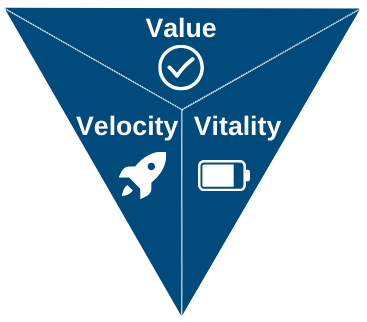
3V NPS is a 90 second, leader-led performance diagnostic. Intuitive, fast and repeatable, it measures team performance across the competing performance dimensions of 3V.
Value - focusing on what’s important.
Velocity - playing the game at pace.
Vitality - ensuring we stay the distance.
When we map the lenses of human-centred design - Viability, Desirability and Feasibility against 3V, the intersection produces a set of performance goals that capture the look and feel of high performing teams.
Using 3V NPS we can summarise “what a high performing team looks like and feels like” into a single number using the customer Net Promoter Score as our NPS metaphor. Customer NPS has been defining customer satisfaction as a single number for over 20 years.
We use a further metaphor, 3V Star Rating, to classify 3V NPS team performance. Like any star rating, you intuitively know how good it is. We go further and name the performance dynamic the team is experiencing.
3V is CoLab’s performance framework. The use of NPS and star rating as performance metaphors are unique to 3V. It is based on years of experimenting and testing the factors that are common to high performing teams across government, commercial products and agile delivery.

Why We Love It
When you’re responsible for multiple teams, the problem isn’t a lack of information, it is a lack of a shared language. Every team measures performance differently, reports differently, and “high performing” often means something different in each conversation.
3V NPS is a favourite because it helps shift the conversation:
Gives leaders a common team performance language that travels across the organisation.
Makes performance conversations honest and specific - not vague and political.
Surfaces the right discussions fast. Performance goal based, clear scoring, no wasted time.
Starts as a leader’s diagnostic and can evolve into a team exercise. Both are legitimate use cases.
Creates a baseline you can actually return to so you know whether things are improving.
When We Use It
We reach for 3V NPS when:
A senior leader wants a fast read on where their teams actually stand, without asking for a formal review.
A manager wants to track whether their investment in team development is moving the performance dial.
A leader standing up a new team wants to define what high performance looks like from day one.
A new leader wants to baseline performance across a group of teams they’ve inherited before deciding where to focus first.
A CIO wants a portfolio view of performance across all their teams to identify where to invest, which teams to learn from, and where to focus coaching and support.
How We Do It
Start with the “speed ninja” version, it takes just 90 seconds:
Pick one team - start with a team you know well or one where their performance is at the front of your mind.
Answer each performance question intuitively - the RAG style answers; NO (Red), Yes BUT (Amber) and YES (Green) are quick to intuitively answer.
Congratulations “speed ninja” - in just 90 seconds you have intuitively baselined your team’s 3V “Speed” NPS and 3V Star Rating.
The big win is you now have a common language and metaphor to discuss team performance that you can share with your team and other leaders. The worst case is we have wasted 90 seconds of your day!
Next steps, when you have more time:
Qualify your answers by adding insights - spend 5 or 10 minutes revisiting each answer adding a sentence or two noting what you have “seen, heard or sensed”. As you write you’ll find you will want to change some of your earlier answers. That’s normal. You are thinking more deeply now, that’s the point and why we call it your 3V “Insights Ninja” NPS.
Share your insights - then later find a peer or a team member. Walk them through your answers & insights and refine them as they share insights. You now have a 3V “Shared Ninja” NPS. Each additional increment of time you invest makes your 3V NPS more robust as a predictor of high performance.
Leverage the wisdom of the crowd - approach this as a team exercise. Use the free 3V Performance Poker workshop guidance to calculate a 3V “Team Reflection” NPS which is an even more robust high performance predictor.
Use your 3V NPS at portfolio level - the 3V Star Rating groups teams at the portfolio level and encourages a shift in conversation from “who’s underperforming?” to “what can we learn from our 5 star teams that we can share across the rest of the teams?”
Things to Look Out For
A team's 3V NPS is a starting point for a conversation - not a verdict. It is a diagnostic, not a report card. It creates performance visibility that helps the leader and the team collaboratively prioritise the performance goal they want to focus on next.
A common trap is turning this into a group exercise too early. If you’re doing it for the first time, do it yourself first. Get your own read on the team before you bring others into it - that way you’ve got something to anchor the conversation.
Watch out for the temptation to average everyone’s scores and call it done. Differences between how people score the same team are the most interesting data in the room. Don’t iron them out - explore them.
And don’t let “Yes BUT” become a place to hide. It’s a useful signal when used honestly. If everything is a Yes BUT, you probably need a harder conversation about what’s actually going on.
Try It With Your Team
We’ve made 3V NPS available as a DIY option so you can use it independently. If you need help and bring in a CoLab coach, we will use the same starting point - it gives us a common language to rapidly agree where to focus our coaching and gives your teams something concrete to work towards.
Download the free 3V Discovery NPS Worksheet and run a performance discovery before your next leadership check-in. It only takes 90 seconds and gives you more useful information than most performance reviews.
If you want more detail on CoLab’s 3V performance framework that supports 3V NPS then click on this link - 3V Performance Framework.
Our RAFT Series
✦ Our CoLab RAFTs - Rapid Agile Forecasting & Tracking skills - are practical tools we use every day in our coaching and training to help teams make work visible and performance-focused.
Curious? Let’s talk toni@agilecolab.com
Version 1, last updated on 15 September 2026