
Innovation Days: Creating Space to Experiment
When too much repetitive work, meetings, dependencies and quality debt slow everything down, teams stop improving. They get stuck in delivery mode with their heads down, working the same way they always have, with no time or creativity to step back and ask if there is a better way.
Innovation Days are a deliberate circuit breaker. Dedicated time to try new ideas, learn fast, and make tomorrow better than today. No governance. No approvals. Just teams with space to deliver something real.
What are Innovation Days?
An Innovation Day is a structured event that lifts people out of day-to-day delivery to experiment, collaborate, and build something new.
Think focused sprint with a purpose and outcome, not a free-for-all. You give people a clear challenge, protected time, and the freedom to actually finish something. The goal is dedicated time to try new ideas and learn fast - at zero-governance speed. The results often surprise everyone.
They go by different names - innovation sprints, ship-it days, build days - but the principle is the same. The key shift is treating it as an investment in your people and ways of working, not a cost to justify. Organisations that approach it that way get very different outcomes.
Why We Love It
Innovation Days create space for things daily delivery rarely allows:
Giving teams permission to experiment with automation, new tools, and smarter ways of working, without waiting for a business case.
Breaking down silos by connecting people who don't normally work together, improving cross-team relationships long after the event.
Building visible proofs of concept that show value to stakeholders in a way a slide deck never can.
Creating a learning space where people explore new tools or approaches without production pressure.
Generating genuine energy and excitement - a real counterweight to continuous delivery cycles.
When We Use It
We reach for Innovation Days when:
Teams are stuck in delivery cycles and losing energy.
Good ideas keep surfacing in retros but never get picked up.
Leadership wants to invest in people but isn't sure how to make it tangible.
Cross-team collaboration has broken down or never really happened.
An organisation wants to demonstrate innovation capability with something real, not just a strategy document.
These events work at any scale. What matters is that people have genuine space to try something and enough time to finish it.
How We Do It
There are five key phases that make an Innovation Day work. Skip one and the energy turns to confusion quickly.
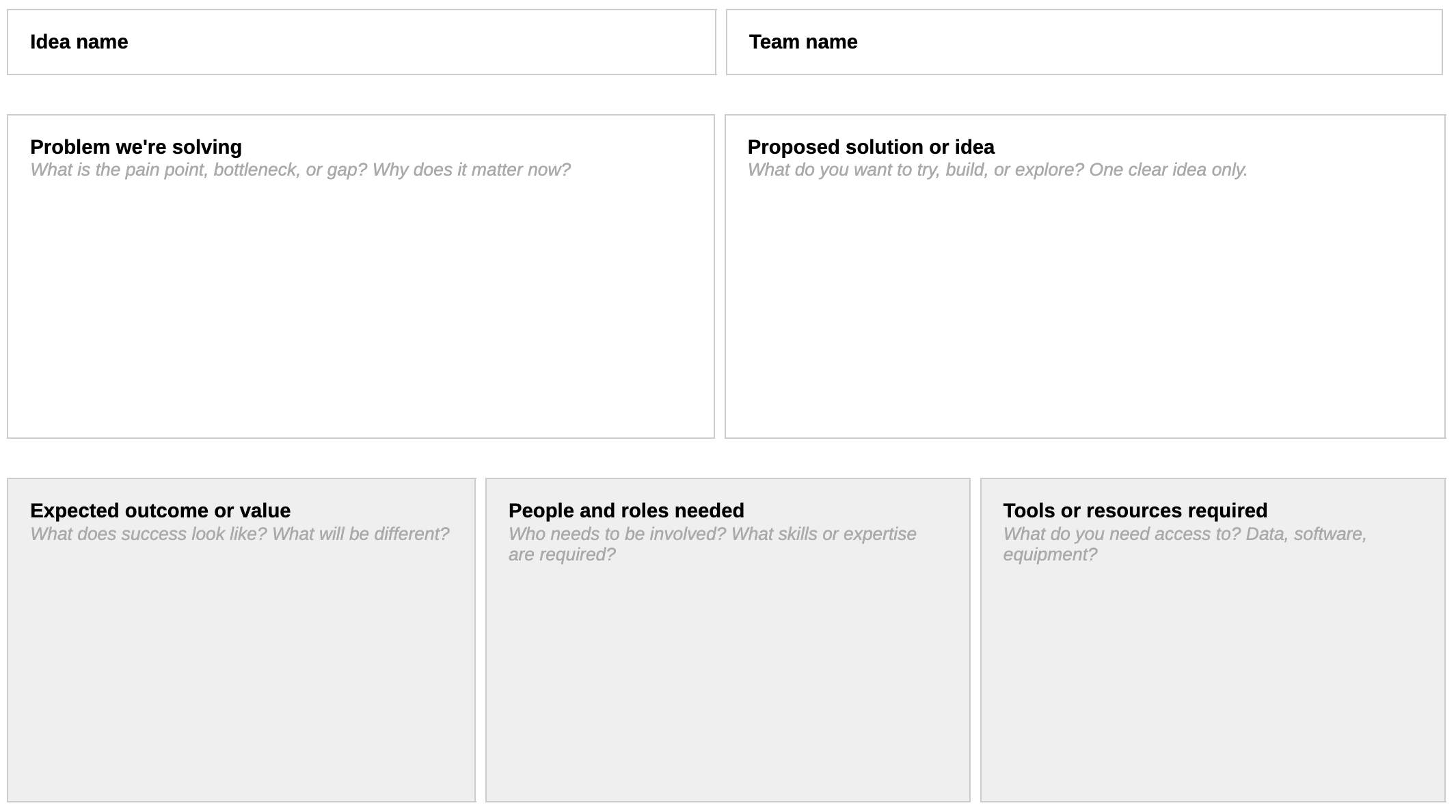
Prepare. Gather ideas upfront - a simple survey works well. Turn the best ones into short 1-page canvases. Get a small group of people aligned on the goals before the event starts.
Prioritise. Share the pitches with senior stakeholders. Get their support for the most viable ideas. This step is what separates a credible event from a fun day out.
Form teams. Give people a genuine choice of project. Teams of five to eight work well. Getting people in the same room makes a noticeable difference to how fast collaboration clicks.
Run the event. Two days works. Three days is better - it gives teams time to get stuck, unstick themselves, and actually finish something. Kick off with leadership framing why it matters. External coaches or vendor partners can help teams stay focused.
Present and recognise. Teams present to leadership with a focus on business value. Finish with recognition and prizes. This is what people remember and what builds appetite for next time.
Things to Look Out For
Lack of genuine buy-in. Mandatory participation creates resentment, not innovation. Frame it as an opportunity.
Unclear goals. Ensure they’re clear upfront so teams don’t spend the event debating scope rather than building anything.
Lack of dedicated time. Two days works but three days is the sweet spot. Whatever you choose, protect the time. People half in the event and half on their day job won't get much out of either.
Ideas that go nowhere. They might get great applause but if they go nowhere afterwards then trust erodes fast. Have a plan for what happens after the event.
Lack of leadership support. Showing up for the final presentations matters as much as the opening speech.
Try It With Your Team
Start small. You don't need a full programme to prove the concept.
A good first Innovation Day is about practising more than producing a perfect output. Initial success is everyone wanting to do it again!
Want hands-on support?
Our Innovation Days facilitation takes care of the design, structure and follow-through so your team can focus on the work. Learn more about the offering.
Our RAFT Series

✦ Our CoLab RAFTs - Rapid Agile Forecasting & Tracking skills - are practical tools we use every day in our coaching and training to help teams make work visible and performance-focused.
Curious? Let’s talk toni@agilecolab.com
Version 2, last updated on 7 September 2026
