Cynefin: Matching your approach to the work
Ever watched a delivery team being forced to commit to a fixed plan for work they have not done before? Or equally as frustrating, watched another delivery team run experiments to solve a problem that was genuinely straightforward?
Cynefin helps delivery teams pause long enough to understand the nature of the problem they are trying to solve, so they can pick a delivery approach that fits, instead of defaulting to gut feel or whatever's familiar.
What is Cynefin?
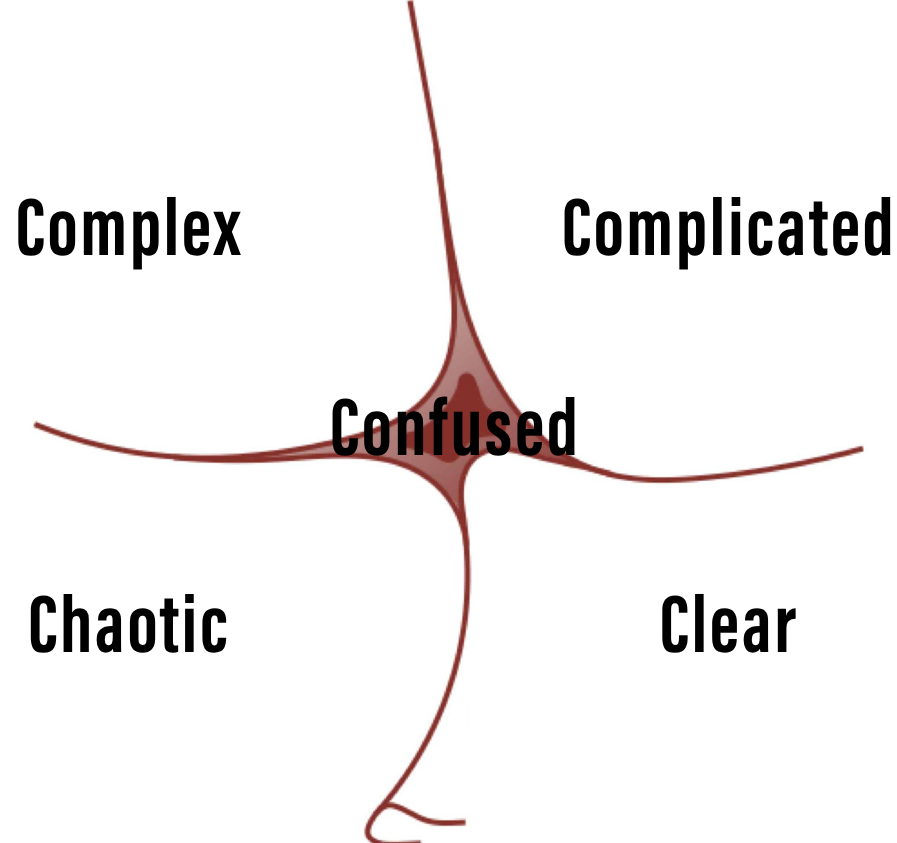
Cynefin (pronounced kuh-nev-in) is a Welsh word meaning “habitat” or “place of multiple belongings”. Developed by Dave Snowden, it offers a practical framework for making sense of uncertainty. It guides decision-makers understand situations based on how clearly cause-and-effect relationships can be mapped.
The framework introduces five distinct domains that map different types of cause and effect relationships. Once a situation is mapped to a Cynefin domain, the framework suggests an appropriate decision-making strategy, from following best practices to experimenting through safe-to-fail probes.
Clear domain, cause and effect is obvious. Categorise it, apply best practice, and act.
Complicated domain, cause and effect is not obvious, but with expert analysis the relationship can be defined and an appropriate solution can be designed and planned before acting.
Complex domain, cause and effect can only be understood in hindsight. Expert analysis becomes misleading, the team need to experiment and reflect on the results before acting. Cynefin describes this as probe, sense what emerges, and respond.
Chaotic domain, there is no discernible relationship between cause and effect. Act first to create stability, then make sense of what you have.
Confused domain describes the state of not knowing which domain you're in. The priority is to break the problem into smaller parts and attempt to assign each piece to one of the other domains.
Clear and Complicated are referred to as "ordered" domains, where cause and effect are known and teams can use a traditional “predictive” delivery approach. We refer to this as big “P” planning. The team knows what they need to deliver and how to get there. They do not expect either to change significantly. Teams working in the Clear or Complicated domains often reach for our Back to Basics with Kanban RAFT, where a steady, visible flow of well-understood work does the job.
Complex and Chaotic are referred to as the "unordered" domains where cause and effect can't be pinned down in advance. Teams are advised to use an “emergent” agile delivery approach in the complex domain. The team understands there is a problem but is unclear what solution would be most effective. So they frame the solution as a small experiment to validate their understanding before committing. We refer to this as little “p” planning. Planning expects change as the team constantly adapts to the feedback from the experiments. Our Innovation Days RAFT is one practical way to create space for these small experiments.
Head to thecynefin.co to learn more about the framework.
Why We Love It
Cynefin is a favourite because it gives the team a shared language to discuss their delivery approach:
Confirms that ordered problems benefit from traditional big “P” predictive planning
Recognises unordered problems are more successful with agile small “p” emergent planning
Helps teams avoid one size fits all delivery approaches for both predictive and emergent work
Explains why “better analysis and requirements” does not improve complex outcomes
Stops teams trying to formally analyse chaotic situations that actually need action first.
Gives leaders a fast way to check whether their teams delivery approach fits the problem.
Makes it safe to say "we don't know which domain this is yet" without that feeling like failure.
When We Use It
We reach for Cynefin when:
A team feels stuck and nobody can agree on why the current approach isn't working.
Leaders are pushing for a fixed roadmap on work that keeps changing shape underneath the team.
A team's certainty or panic doesn't match the actual nature of the problem.
A piece of work spans several types of problem and needs breaking apart before it can be planned.
We're helping a team pick a delivery framework and want the choice grounded in the work, not habit.
We use it to help teams understand their type of work and choose an appropriate delivery framework, weighing up predictive versus emergent approaches rather than defaulting to one or the other.
How We Do It
We usually run Cynefin as a short, visual conversation. Sketch the four domains on a whiteboard and start plotting real, current pieces of work onto it together.
Build shared situational awareness - having a Customer Story Mapping helps get everyone looking at a picture of the current situation before you try to sort anything. Lack of context is where most of the real friction in a backlog actually lives.
Understand the work - talk through what's actually going on, not just what's written on the ticket. Constraints from the organisation, stakeholders and any vendor relationships usually surface fast once you start asking.
Sort it as a team - map each piece of work onto Clear, Complicated, Complex or Chaotic, out loud, together. Don't rush it. Disagreement here is useful information, not a problem to solve quickly.
Triage from there - once everyone's looking at the same picture, deciding what to do with each piece gets a lot easier.
That's it. Simple, visual and usually a bit revealing. Most of the value comes from the conversation the sorting creates, not the labels themselves.
Things to Look Out For
Don't aim for perfection - this is a conversation tool, not a label. Good enough to create initial clarity is the goal. The domain may change as you discover more about the problem.
Watch your personal bias - teams naturally lean toward the domain that matches how they like to work, whether that's big “P” predictive planning or experimentation, regardless of what the problem actually calls for. Naming that personal bias early is half the value of using Cynefin.
Complex isn't Complicated - leaders can mistake one for the other and ask for commitments a team working in the complex domain can't give yet.
Watch the cliff edge - the boundary between Complex and Chaotic can collapse fast if a team ignores early warning signs. Snowden calls this the "cliff edge" for good reason.
Try It With Your Team
We recommend trying Cynefin on work you already know well before using it on something contentious. Pick three or four current pieces of work and place them across the four domains together, out loud.
Cynefin won't make the work simpler, but it will stop your team fighting the wrong problem with the wrong approach.
Most digital product delivery work sits closer to Complex than delivery teams expect. You are rarely just executing a known solution, you're discovering the right one as you build it.
Our RAFT Series
✦ Our CoLab RAFTs - Rapid Agile Forecasting & Tracking skills - are practical tools we use every day in our coaching and training to help teams make work visible and performance-focused.
Curious? Let’s talk toni@agilecolab.com
Version 1, last updated on 22 July 2026