
DevOps Maturity Model: A Roadmap, Not a Report Card
If you feel like your team is constantly putting out fires despite having a CI/CD pipeline in place, you aren't alone. DevOps is a journey but it often feels like navigating a dense forest without a map.
It’s easy to get overwhelmed by the sheer volume of methodologies and buzzwords, leaving teams stuck in a state of 'functioning but frustrated'.
A DevOps Maturity Model can help you but should not be used as a rigid grading system. It should be used as a navigational tool designed to help you understand your current coordinates and chart a sustainable path toward delivering value faster and safer in the hands of an end user.
What is a DevOps Maturity Model?
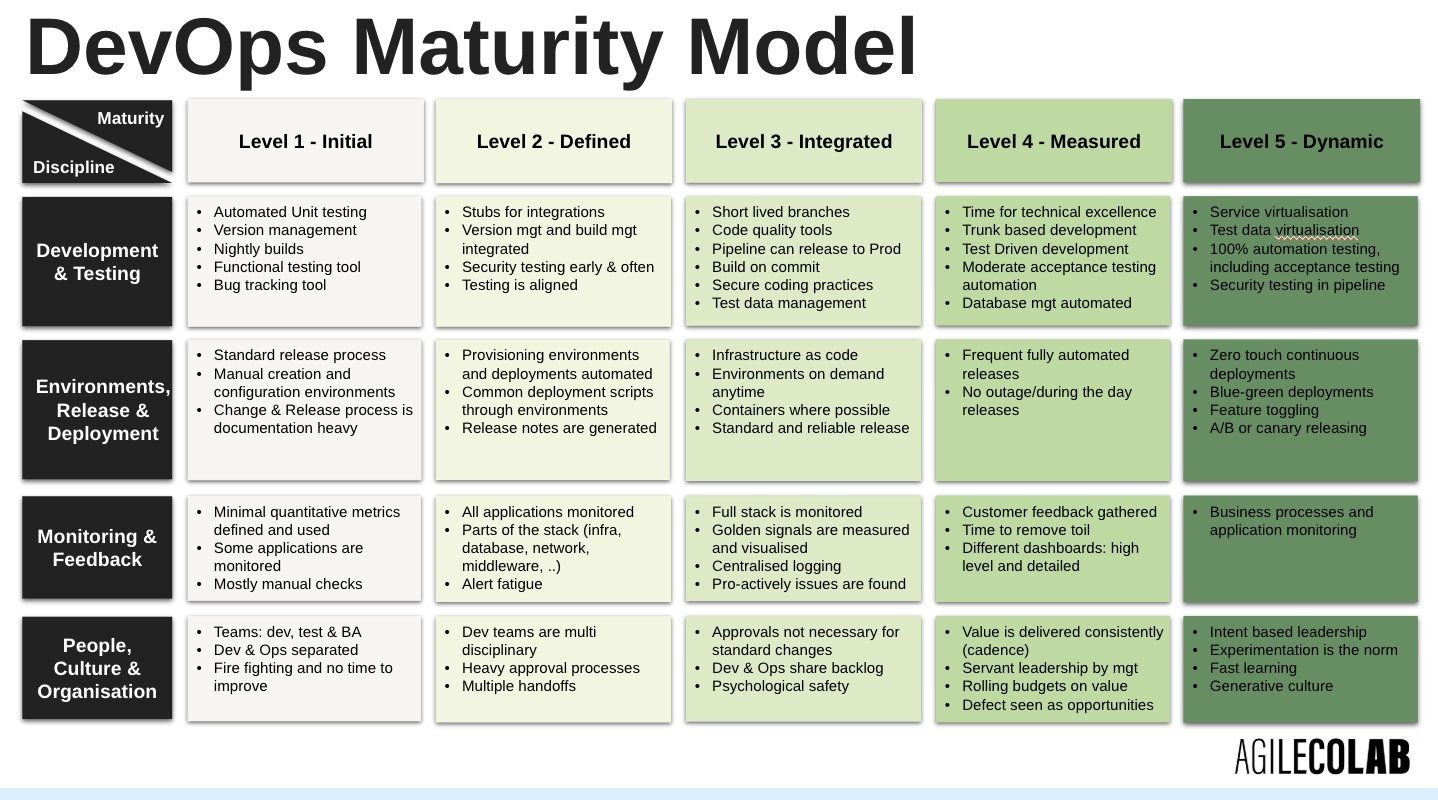
Our DevOps Maturity Model is a lightweight assessment framework that helps teams see where they are now and plot a realistic path forward. It assesses four critical dimensions of DevOps capability across five maturity levels.
This isn't a new invention and isn’t trying to be. We have adapted established maturity thinking into a practical CoLab RAFT that teams can use to have honest conversations about capability and investment.
The Four Dimensions:
Development & Testing - How code is built, integrated and tested.
Environments, Release & Deployment - How environments are managed and releases happen.
Monitoring & Feedback - How systems are observed and performance is tracked.
People, Culture & Organisation - How teams are structured and work together.
The Five Levels:
Initial - Manual processes, reactive approaches, inconsistent practices. Think: nightly builds, manual deployments, teams in silos.
Defined - Some standards and tools are emerging but still inconsistent. Think: stubs for testing, provisioning scripts, some cross-functional collaboration.
Integrated - Core practices automated and standardised. Think: short-lived branches, infrastructure as code, full-stack monitoring, shared backlogs between Dev and Ops.
Measured - Optimised for speed and quality with sophisticated practices. Think: trunk-based development, zero-touch deployments, proactive monitoring, servant leadership.
Dynamic - Continuous innovation and improvement as the norm. Think: service virtualisation, blue-green deployments, business process monitoring, intent-based leadership.
Improving your DevOps practices directly improves your team's performance. The 3V Performance Framework is how we measure the difference - specifically across Vitality, where most DevOps gaps show up first.
Where you see yourself in these levels and dimensions will help inform the direction you take.
Why We Love It
(with caution)
Used well, this model helps shift the conversation:
Creating a shared view of the current state without blame or judgement.
Identifying capability gaps that actually matter to your context.
Building a roadmap that matches your investment appetite.
Making trade-offs visible between dimensions.
Giving leaders the "maturity language" they understand while teams focus on practical improvement.
The Big Caveat - Maturity models can be misused. They become dangerous when organisations treat them as any of the following. These are big red flags.
A performance scorecard for teams.
A mandatory march to Level 5 in everything.
A comparison tool between teams.
A consultant's meal ticket for endless "improvement".
When We Use It
We reach for the DevOps Maturity Model when:
Teams want to create a practical, capability development roadmap.
Leaders are asking "how mature is our DevOps?" to identify what is the next step to improve the delivery of value.
Organisations are planning DevOps investment and need to prioritise.
Multiple teams want to identify common improvement areas.
We need a baseline before major transformation work to help measure our progress.
The key is using it as a conversation starter, not a final verdict. The best assessments spark discussions about priorities, constraints and what "good enough" looks like for your specific context.
How We Do It
We typically run this as a collaborative assessment workshop, not a scoring exercise. If it is hard to get everybody in one room we also can work with teams or even individual interviews in certain cases. It is about a real and good picture of the DevOps practices and capabilities.
Prepare the team - Understand the why. What do you want to achieve with DevOps? Gather representatives across the delivery value stream. Set the expectation that this is about roadmap creation, not judgment.
Assess each dimension - We work through each dimension using assessment questions. Plot your current state honestly and don't force consensus if there's genuine disagreement.
Identify your target state - Decide what level is "good enough" for your context in each dimension and is aligned with your intended organisational outcome. Not everything needs to be Level 5. Consider your constraints: people, skills, time, budget, risk tolerance, regulatory requirements.
Build your roadmap - A proposal for your roadmap will be created by the facilitator and together you will prioritise the gaps that matter most to your business outcomes. Sequence improvements based on dependencies and impact.
Revisit regularly - Track progress over time (quarterly or bi-annually). Adjust targets as context changes and celebrate movement, not just destination.
Things to Look Out For
Don't chase Level 5 everywhere - Only invest in higher maturity where it delivers business value. A Level 2 deployment process might be perfectly fine for a low-change internal system.
Context matters more than score - A startup and a bank will (and should) have different maturity profiles. Regulatory environments, risk tolerance and business models all affect what "good" looks like.
Beware the maturity police - If this becomes a performance management tool or a stick to beat teams with, you've lost the plot. It's a roadmap tool, not a report card.
Aim for even maturity - It's more effective to be in the same levels for all categories, but a perfect balance is not the goal.
Movement matters more than position - Improving from Level 1 to Level 2 in a critical area is more valuable than polishing Level 4 to Level 5 in something that doesn't matter.
Teams know their reality - If the assessment says Level 3 but teams feel like they're firefighting constantly, believe the teams. The model is a guide, not gospel.
Don't avoid the differences - If different people assess the same dimension very differently, that's valuable data. Explore why rather than averaging to consensus.
Try It With Your Team
Start with a self-assessment. Download the DevOps Maturity Model Levels, work through the practices with your team and see where you stand. Try to fill in gaps in the lower levels first because it is easier to do and has the most impact. Work through the practices together as a team and get consensus on an answer. This helps you learn the model without the pressure of a formal assessment
Want something lighter first? The DevOps Quick Assessment is a great way to find your low-hanging fruit before committing to the full workshop.
Ready to plot the path forward? The Transformation Map turns your baseline into a sequenced roadmap across realistic time horizons.
Want a CoLab coach to run it with you? We can run a full assessment workshop and use the results to build a capability roadmap that matches your appetite for investment.
Our RAFT Series

✦ Our CoLab RAFTs - Rapid Agile Forecasting & Tracking skills - are practical tools we use every day in our coaching and training to help teams make work visible and performance-focused.
Curious? Let’s talk toni@agilecolab.com
Version 3, last updated 15 August 2026
