
Transformation Map: Turning a Baseline into a Roadmap
Ever started a transformation and six months in, nobody can actually explain what you're transforming into?
You're a few years into "the DevOps journey." Leaders want to see progress, teams want to know what's next and someone's already talking about the next initiative. Meanwhile, everyone's working hard but there's no shared picture of where you're heading or how it all connects.
Transformation Maps are a practical way to make the path visible and keep everyone aligned on what matters when.
What is a Transformation Map?
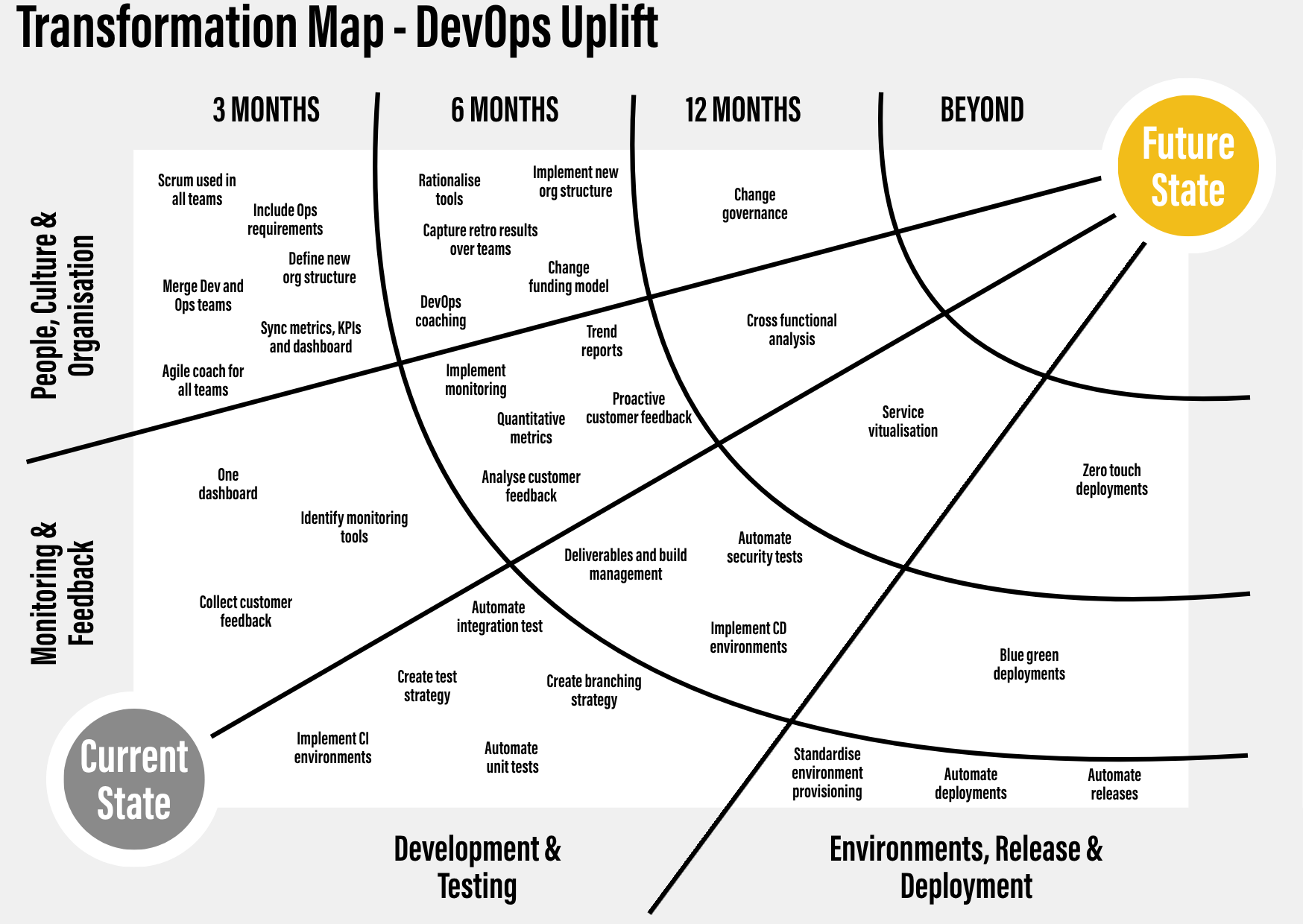
A Transformation Map is a simple visual that shows what you're changing, when you're changing it and how it all connects.
It's a two-dimensional map where each improvement or initiative gets placed on the map based on when you'll tackle it and which capability it belongs to.
Time Horizons - typically 3 months, 6 months, 12 months, future state
Dimensions - Development & Testing; Environments, Release & Deployment; Monitoring & Feedback; People, Culture & Organisation
What makes it useful is what it shows you immediately: where dependencies exist, where you're overcommitting, what needs to happen before something else can start and how the pieces connect into a coherent transformation story.
This isn't sophisticated project planning. It's a communication tool that keeps everyone looking at the same picture of where you're headed.
For DevOps transformations specifically, the Transformation Map works hand-in-hand with our DevOps Maturity Model. The maturity model helps you assess where you are now across the four dimensions. The Transformation Map plots your path from that current state toward your target state, showing the sequence of improvements over realistic time horizons.
Why We Love It
Talking about a transformation isn't the same as seeing it. Transformation Maps turn the conversation into something everyone can look at and point to. They help shift the conversation by:
Making the full journey visible so everyone sees how their work connects.
Surfacing dependencies before they become blockers.
Showing realistic sequencing instead of wishful thinking.
Giving leaders confidence there's a plan, not just activity.
Preventing overcommit by making the scale of change obvious.
Creating a shared language for talking about transformation progress.
When We Use It
We reach for Transformation Maps when:
Starting a significant DevOps transformation.
Leadership needs visibility of the transformation roadmap.
Teams are overwhelmed by too many improvement initiatives at once.
Stakeholders need to understand sequencing and why things can't happen faster.
Six months into change and people are losing sight of the bigger picture.
Different teams are working on improvements but not coordinating.
It's especially useful when you're changing multiple things at once and need everyone looking at the same picture.
How We Do It
We typically run this as a collaborative assessment workshop with key people from across the transformation scope.
We assess the current state using our DevOps Maturity Model. This gives the baseline.
We agree what the future needs to look like to improve performance.
We define the time horizons - typically 3 months, 6 months, 12 months and "future". Nearer horizons get more detail.
We map the dimensions down the left - for DevOps that's Development & Testing; Environments, Release & Deployment; Monitoring & Feedback; People, Culture & Organisation.
We brainstorm all initiatives and place each one in the right dimension and time horizon. The conversation surfaces dependencies. If something needs foundational work first, we move it right.
We step back and look for patterns. Where's the effort concentrated? Are there logical progressions? Obvious gaps?
We test dependencies by drawing lines between connected initiatives. Does the sequence actually work?
We refine and commit, adjusting until the map feels achievable, not aspirational.
We revisit quarterly to track progress, adjust timing and add detail as future horizons get closer.
Things to Look Out For
Don't pack the early horizons - If your first 3 months is full, you're lying to yourself. Be honest about what's achievable.
Sequence beats speed - Do foundational work properly rather than rushing ahead and creating debt.
Balance the dimensions - If all initiatives sit in one row, you're not transforming, you're just buying tools.
Keep it visible - A map in a deck helps nobody. Put it where everyone can see it.
Progress isn't linear - Things take longer than expected. Revisit and adjust. The map guides, it doesn't lock.
Try It With Your Team
We recommend starting with a transformation you're already planning or midway through.
Run a half-day workshop with key stakeholders to build the map collaboratively. Start with an honest assessment of the current state. The DevOps Maturity Model works well for this or the DevOps Quick Assessment if you want to learn what matters most before you commit to the bigger picture.
Then plot the journey forward. You'll quickly see where alignment breaks down, what sequence makes sense and where you're overcommitting.
Once the map exists, the next question is whether it's working. Track whether your improvements are actually moving the needle with the 3V Net Performance Score.
Our RAFT Series

✦ Our CoLab RAFTs - Rapid Agile Forecasting & Tracking skills - are practical tools we use every day in our coaching and training to help teams make work visible and performance-focused.
Curious? Let’s talk toni@agilecolab.com
Version 2, last updated 15 August 2026
